Africa · Western Africa
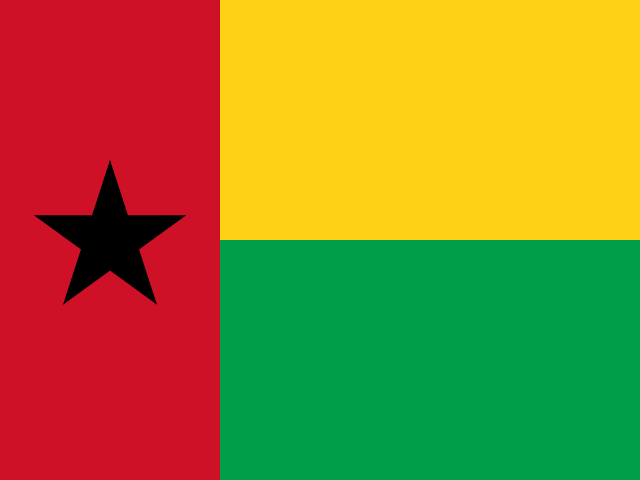
How to draw Guinea-Bissau from memory
Guinea-Bissau is a single continuous landmass, wider than it is tall. Lock that proportion in before you worry about any individual stretch of border. Its border sits in the middle of the difficulty range — enough straight sections to anchor you, enough detail to punish a careless stroke.
- Difficulty
- medium
- Population
- 1.9 m
- Code
- GNB
Draw Guinea-Bissau
Practice · draw from memory
Guinea-Bissau
A four-step strategy for Guinea-Bissau
- 01
Draw a wide, shallow guide box in your head first — Guinea-Bissau is much wider than tall, and getting that ratio right is worth more than any single coastline.
- 02
Anchor one unmistakable feature — the straightest border section or the sharpest cape — and draw outward from it in a single continuous stroke.
- 03
Close the loop back to where you started. An open shape gets filled unpredictably and drags your score down.
- 04
Submit, read the nine-sector grid, and redraw immediately. The sector readout names the region you under-drew, and a second attempt typically gains 10–20 points.
Why Guinea-Bissau is scored this way
Country Drawing does not compare your sketch to a picture of Guinea-Bissau. It scales and centres both your stroke and the real border into the same box, fills them, and measures how much of the two shapes overlap relative to their combined area. That means you are never punished for drawing Guinea-Bissau small, off to one side, or rotated slightly — only for getting the shape itself wrong. The nine-sector grid then splits the real border into a 3×3 mesh and reports coverage per cell, which is how it can tell you that you lost the whole eastern edge rather than just handing you a number.
Top scores for Guinea-Bissau
Nobody has submitted a score for Guinea-Bissau yet. Draw it above and you are first on this board.
Full leaderboard →Quick facts
- Continent
- Africa
- Subregion
- Western Africa
- Outline pieces
- 1
- Detail score
- 3.65
Draw these next
Countries near Guinea-Bissau share border conventions and coastline styles, which makes them the most useful follow-up practice.